

August Webinar Key Takeaways: From Straddles to Butterflies, a Volatility Toolkit
This month, OIC hosted two webinars on positioning around market movement: Beyond Directional Thinking: Understanding Straddles and Strangles and Four Legs, One Position: How Condors and Butterflies Are Built, both led by OIC instructor Ken Keating. The first covered straddles and strangles, strategies built to profit from a big price swing in either direction. The second showed how combining spreads creates condors and butterflies, letting a trader sell high implied volatility while keeping risk defined. Together, the sessions move from strategies that need a big move to strategies that profit when a stock stays calm.
What We Covered:
The Long Straddle: Positioning for a Big Move
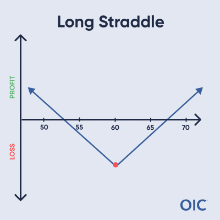 A long straddle is built by buying a call and a put at the same strike price and expiration date, usually the at-the-money strike. Because the position profits from a large move in either direction, the trader doesn't need to predict which way the stock will go, only that it will move enough to clear one of two break-even points.
- The most a straddle buyer can lose is the premium paid, since both options are purchased outright, and break-evens come from adding that premium to the strike on the upside and subtracting it on the downside. The position also carries positive Vega, so rising implied volatility helps even without stock movement, while quiet, flat trading works against it through time decay.
The Long Strangle: A Lower Cost, Wider Break-Evens
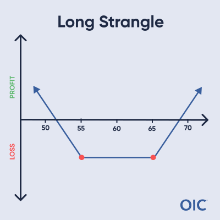 A long strangle swaps the at-the-money strikes for an out-of-the-money call and put, which lowers the up-front cost of the position compared with a straddle, while keeping the same basic goal of profiting from a large move in either direction.
- Because the strikes sit further from the current price, a strangle needs a larger move to become profitable, and its break-even points are wider than the straddle's. The trade-off for paying less premium is needing more movement before expiration to realize a profit.
From Spreads to Condors: Defining Risk on Both Sides
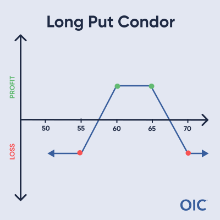 A traditional long condor uses four calls, or four puts, at four different strikes, combining a bought spread with a sold spread. The position costs a net debit and profits if the stock settles between the two inner, short strikes at expiration, with maximum gain and loss both set in advance.
- An iron condor reaches a similar payoff by combining a put credit spread with a call credit spread, producing a net credit instead of a debit. Because it costs money to enter, a long condor tends to suit lower implied-volatility environments, while an iron condor lets a trader sell elevated premium when volatility is higher, with the wings still capping the risk.
The Long Butterfly and Iron Butterfly: Profiting From a Stock That Pins (Closes Exactly at a Strike)
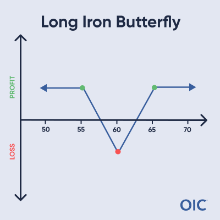 A long butterfly sells two at-the-money calls, or puts, and buys one in-the-money and one out-of-the-money option against them, all in the same expiration. The position costs a net debit, and maximum profit occurs only if the stock closes exactly at the middle strike, an outcome that's possible but statistically unlikely.
- An iron butterfly reaches a similar payoff shape by selling an at-the-money call and put together, essentially a short straddle, and buying further out-of-the-money wings for protection, producing a net credit instead of a debit. As with the condor pairing, the debit version tends to fit a low-volatility outlook, while the credit version suits periods of elevated volatility.
Reading the Greeks and Choosing a Structure
- Condors and butterflies, whether the debit or credit version, are typically Theta positive as long as the stock stays near the short strikes, meaning time decay works in the trader's favor. That flips once the stock pushes toward the outer wings, where time decay starts working against the position.
- All four of these defined-risk structures carry a slightly negative Vega, so falling implied volatility helps them while rising volatility works against them, the opposite of the straddle and strangle, which are long Vega positions. Choosing a debit or credit version often comes down to that volatility environment: cheap premium favors debit spreads, rich premium favors credit spreads.
Keep Learning:
Key Moments from Beyond Directional Thinking: Understanding Straddles and Strangles
Key Moments from Four Legs, One Position: How Condors and Butterflies Are Built
Meet OIC Instructor

Ken, OIC instructor and principal, Investor Education at OCC, began his 25-year trading career at Group One Trading in 1993 on the floor of the PSE (Pacific Coast Stock Exchange) and later transitioned to the floor of the CBOE (Chicago Board Options Exchange). He has held positions as a floor market maker, floor specialist, risk manager, and off-floor prop-trader.