

Articles and Updates
November 2026
Cracking the Binary Code of Options Trading
At first glance, binary options look straightforward: an all-or-nothing payout based on a simple yes-or-no commitment regarding an asset's price or an event outcome.
A trader picks an asset (stock, a currency, a commodity or event), predicts the price movement and places a trade.
A correct prediction earns a fixed payout.
A wrong prediction forfeits the premium paid.
Unlike stock or a call (put) investment, where you have a range of outcomes, binary options are different having only two outcomes: a fixed cash payout if correct, or zero if it is incorrect.
The binary option's all-or-nothing structure folds everything into a single question: will the underlying price be above or below a specific level at a specific time? Binary options tend to be short-lived, which makes them better suited to short-term market views rather than long-term investing.
Once a binary option is acquired, the holder has no further decision to make regarding exercise, because binary options exercise automatically. A binary option does not give the holder the right to buy or sell the underlying asset. Instead, when it expires, the holder receives either a pre-determined amount of cash or nothing at all. However, like standard options, binary options give the investor the ability to trade out of the position before expiration.
The core principle behind a binary option’s price is probability. The more likely an outcome, the more the contract costs and the smaller the potential profit. A less likely outcome costs less but offers a larger potential profit. In other words, a contract on a likely outcome is expensive with a small potential profit, while a contract on an unlikely outcome is cheap with a larger one.
Example: Binary Option
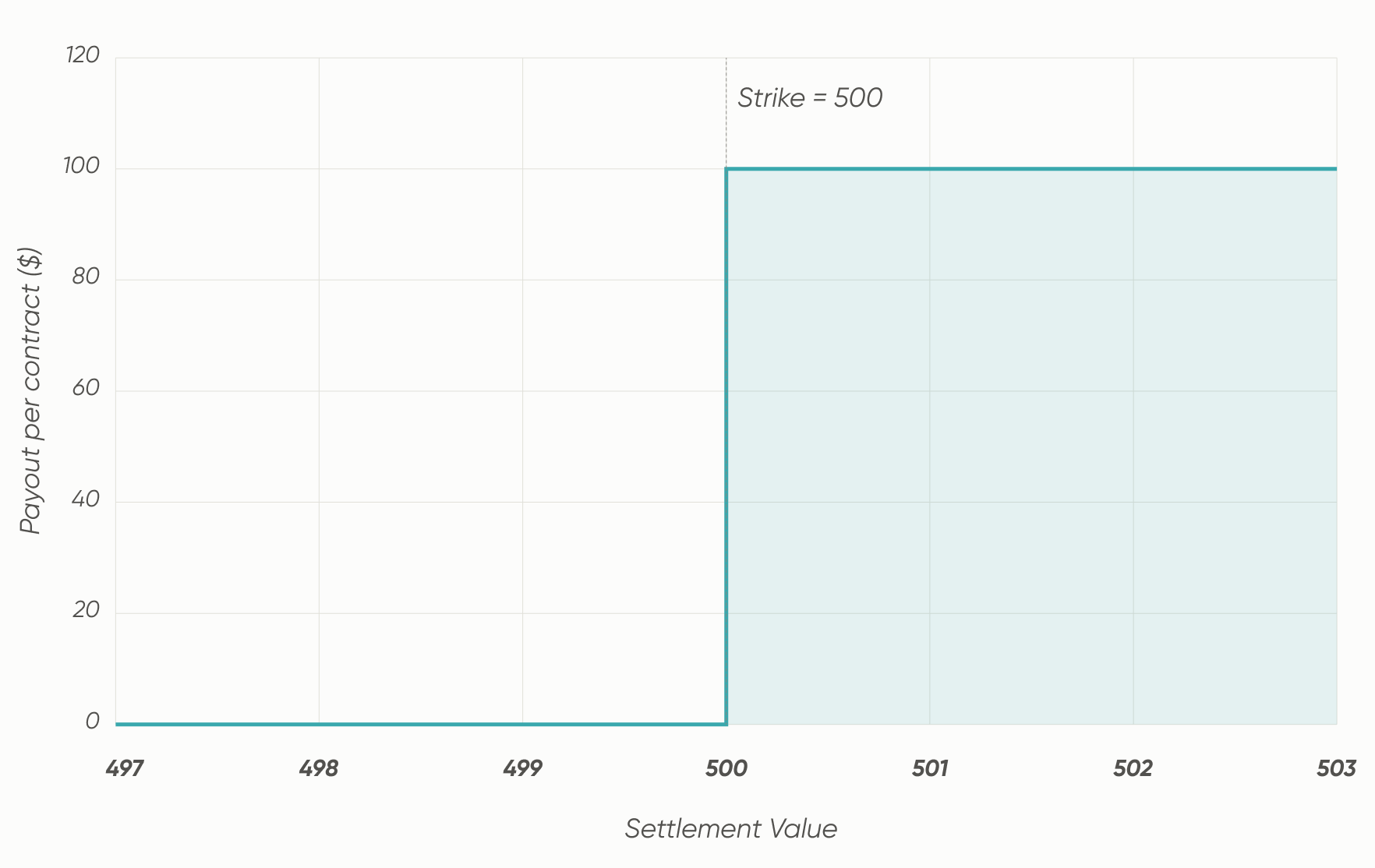
An Index is trading at 500, a trader believes the index will close the trading day above 500.
- The trader buys a Binary Option with a strike price of 500, expiring that same day.
- Each contract has a fixed payout of $100 if the option finishes in the money, or $0 if it doesn't.
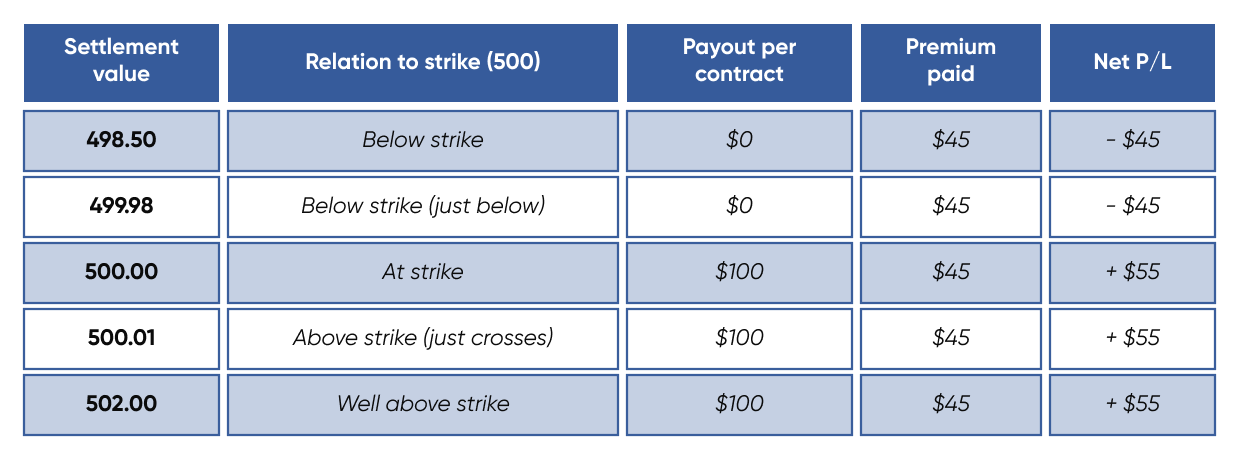
- The trader pays a premium of $45 for the contract.
At expiration:
- The trader nets a $55 profit ($100 − $45 paid).
- If it settles below 500 (say, 499.98), the call pays $0, and the trader loses the entire $45 premium.
- No pin risk. With standard options, a settlement price at or very near the strike can leave it unclear whether an option will be exercised or assigned, which can result in an unexpected position. Binary options have no such ambiguity. The outcome depends only on whether the settlement value is at or above 500, so the contract pays either $100 or $0, with no assignment and no resulting position to manage.
Listed binary options offer a cleaner, more transparent way to take a defined-risk, directional view. The structure is trading in its simplest form: a yes-or-no assumption with a fixed outcome. There are no runaway losses and no need to understand the complex math behind implied volatility, Greeks and pricing models. But simplicity is not the same as safety, understanding exactly where the strike sits, and what happens on either side of it is what turns this defined risk into a known one.