

Articles and Updates
September 2026
Options Market Makers: The Hidden Machinery Behind Every Trade
Each option trade executed, whether buying or selling, passes through one of finance's most complex and least understood structures: the options market maker. These traders play a critical role at the core of the derivatives markets.
Meet the Market Maker
Options market makers hold a unique place in the financial ecosystem. As exchange members — known as Trading Permit Holders (TPHs) — market makers are contractually obligated to provide continuous two-sided markets by simultaneously quoting bids and offers on a given contract and ensuring there is always a price for an investor to trade in all market conditions.
When corporations hedge real-world risk, investors speculate on price moves, or funds manage portfolio exposure, market makers often take the other side. In doing so, market makers absorb the risk embedded in each contract.
Market making sits at the intersection of mathematics, statistics, technology and real-time decision making. Modern market making firms rely on sophisticated models to price options accurately and to capture how positions across different underlyings move in relation to one another.

The market maker's two-sided quote
Volatility, Not Direction
Unlike most market participants, market makers don't evaluate their performance trade by trade, and profit and loss is less about any individual transaction and more about the overall exposure to implied volatility and the uncertainty attached to that trade.
Market makers track and manage their positional exposure using the Greeks, primarily. Each Greek quantifies how a position's value responds to changes in market conditions — whether that's a move in the underlying price, a shift in implied volatility, the passage of time, or a change in interest rates. This analysis gives market makers a precise, real-time picture of where their risk is concentrated.
The Balancing Act
Market makers are continuously adjusting positions to keep the overall position Delta-neutral as the market moves. In practice, this means buying and selling the underlying stock dozens or even hundreds of times a day, not because they have a view on its direction, but simply to offset the directional risk through this continuous rebalancing of the position.
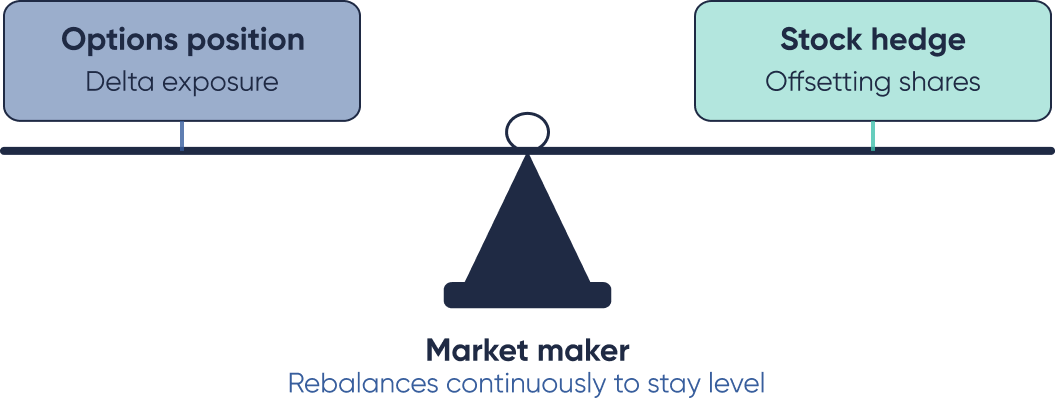
Staying Delta-neutral as the market moves
Bringing It All Together
Market makers aren't trying to guess where stocks will go tomorrow or next quarter; that's a game for directional traders and portfolio managers. Instead, their edge comes from pricing risk accurately in the moment: quoting a fair bid and offer, managing exposure across thousands of positions, and adjusting hedges as conditions shift, all in real time. This is what separates market making from directional trading. Rather than taking a directional bet, market makers stay Delta-neutral, often isolating their exposure to implied volatility alone. And when they functions well, it does so quietly, invisibly, keeping markets liquid and efficient for market participants.